

When Business Can’t Afford to Stand Still
There is a significant difference between having fuel and having the right fuel strategy.
Across South Africa, businesses are operating in an environment where every delay, unnecessary kilometre and unproductive hour carries a cost. Port congestion can leave trucks standing. Border delays can disrupt carefully planned routes. Diesel price movements can change margins almost overnight, while agriculture, mining, construction and logistics businesses still need to keep equipment running, vehicles moving and commitments to customers.
These are the realities behind this month’s newsletter.
At Virgin Fuels, we believe the conversation around bulk fuel needs to extend beyond the price per litre. Of course, price matters. But so do reliability, planning, security, fuel quality, delivery timing and having a supplier that understands the operational pressures behind every order.
That is why this edition looks at some of the less obvious issues influencing fuel-dependent businesses right now. We explore the hidden fuel cost of congestion, the impact of cross-border delays, preparation for the approaching agricultural season, what August’s diesel increase means for operating margins, security around fuel deliveries and how mining’s transition toward a more technology-driven future still depends on reliable energy today.
What connects all these conversations is resilience.
Our role at Virgin Fuels is to help customers build more of it into their operations. We want to understand your business, anticipate requirements and help you make smarter fuel decisions before an urgent requirement becomes an operational problem.
South African businesses have always been remarkably good at adapting. In a market that continues to change, preparation and dependable partnerships matter more than ever.
Thank you to our customers for continuing to place your trust in Virgin Fuels.
The Queue You Pay for Twice
Why congestion should be measured in productivity per litre, not only hours lost.
A truck standing still can be surprisingly expensive. In August 2026, renewed pressure around Durban’s container terminals and truck bottlenecks is a reminder that congestion does more than delay cargo. It changes fuel economics.
When vehicles crawl, idle, reroute or wait for loading slots, diesel is being consumed without productive kilometres being added. The obvious cost is the fuel burnt in the queue. The less obvious cost is what happens next: missed delivery windows, overtime, rushed return legs, disrupted driver schedules and assets that complete fewer revenue-generating trips.
For South African transporters, manufacturers and distributors, this makes congestion a fuel-management issue as much as a logistics issue. The question is no longer simply, “What is our diesel price per litre?” A better question is, “How much diesel are we consuming per completed job?”
That distinction matters in a month when diesel prices have risen sharply while petrol has moved in the opposite direction. Diesel-dependent businesses cannot control port traffic or road congestion, but they can build more resilience into the way fuel is planned.
Compare fuel consumption against completed routes, identify recurring waiting points, coordinate refuelling with realistic dispatch windows and keep enough on-site fuel capacity to avoid adding an unnecessary fuel stop to an already delayed day.
The cheapest litre is not always the biggest saving. Sometimes the real saving is removing the hour in which the litre produced nothing. In a constrained logistics environment, productivity per litre is becoming a far more useful measure than price alone.

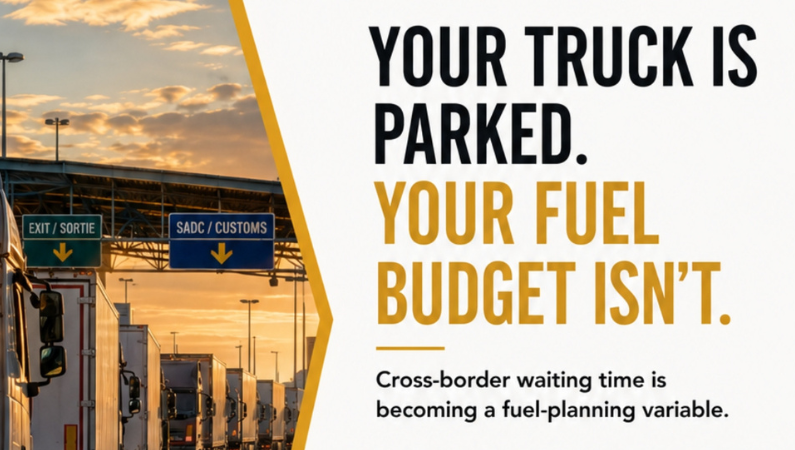
Your Truck is Parked. Your Fuel Budget Isn’t.
Cross-border waiting time is becoming a fuel-planning variable.
Cross-border trade is growing across Southern Africa, but a truck can still lose an extraordinary amount of productive time between departure and delivery. Border queues, documentation problems, inspection delays and changing traffic volumes can turn a carefully costed route into an expensive waiting game.
For fleet operators, the danger is that border delay is often treated as a scheduling problem after the fuel budget has already been set. Yet every additional hour affects idling, refrigeration, auxiliary equipment, driver time and the timing of the next fuel uplift. A vehicle may be stationary, but the operating cost is not.
The smarter response is to plan fuel around corridor behaviour rather than distance alone. Two routes of similar kilometres can have very different fuel realities if one regularly experiences long queues or unpredictable clearance times.
Businesses moving freight through regional borders should build route-specific fuel assumptions, identify reliable refuelling points before and after crossings, and avoid running tanks unnecessarily low when delays are possible. Dispatch teams should also connect border information with fuel planning so that a delay triggers an operational response before it becomes an emergency.
This is especially important for temperature-controlled loads, mining supply chains and time-sensitive deliveries where an unexpected stop can have consequences far beyond diesel consumption.
In 2026, competitive logistics is increasingly about managing the spaces between kilometres. The border post may not be under your control, but your preparation is. A well-planned fuel strategy gives the fleet one less uncertainty to solve while the wheels are waiting to move again.
Before the First Seed Hits the Soil
The 2026/27 summer crop season starts long before planting day.
August may still feel like winter, but South Africa’s next summer crop season is already entering the planning room. From mid-October, planting activity begins to accelerate, and farmers, contractors and agricultural suppliers are making decisions now that will shape the cost of the season ahead.
This year, the conversation is bigger than diesel alone. Fuel, fertiliser, transport and global energy markets are increasingly connected. When international energy routes are disrupted, the effect can reach a South African farm through both the diesel tank and the fertiliser invoice.
That makes August a valuable preparation window. Instead of waiting for planting pressure to arrive, agricultural businesses can map expected diesel demand by activity: land preparation, planting, irrigation, harvesting support and transport. Contractors can do the same across client schedules to identify where demand peaks may overlap.
The aim is not to stockpile blindly. It is to understand the litres required to keep critical work moving and to create realistic delivery triggers before the season becomes busy. Tank condition, meter accuracy, access for delivery vehicles and emergency contact procedures should also be checked now, while there is still time to correct problems.
Agriculture rarely gets to choose its perfect operating day. Weather, soil conditions and crop timing decide when the window opens.
When that window arrives, fuel should not be the reason machinery stands still. The strongest fuel plan is often the one built weeks before the first tractor enters the field – when there is still time to think, inspect, forecast and prepare.

The August Split Screen: Petrol Down, Diesel Up
What August’s unusual fuel-price divergence really means for diesel-dependent businesses.
South Africa’s August 2026 fuel adjustment delivered a strange headline: petrol became cheaper while diesel became significantly more expensive. For households, that can look like welcome relief. For the industries that physically move and build the economy, the picture is very different.
Diesel sits deep inside the cost structure of road freight, mining, agriculture, construction, generators and heavy equipment. A diesel increase therefore travels further than the forecourt. It can appear in the cost of moving a pallet, excavating a site, harvesting a field, running a cold chain or delivering raw material to a factory.
This is why businesses should resist treating the monthly fuel adjustment as a simple price announcement. The more useful exercise is to calculate where the increase will land inside the operation.
Which contracts allow fuel-related adjustments? Which routes have thin margins? Which customers are expensive to service? Which machines consume heavily during idle periods? Which sites are ordering too frequently because storage is poorly scheduled?
The answers reveal where a fuel increase becomes a margin problem – and where it can still be managed.
August also demonstrates how quickly different fuel products can move in opposite directions. Global oil conditions, product-specific international pricing, exchange rates and local pricing mechanisms do not always produce a uniform result. Diesel-dependent businesses therefore need their own operating view of the market, rather than assuming the consumer petrol headline reflects their reality.
A useful August conversation is not, “How much did diesel go up?” It is, “What does this increase change in our business?”
Review high-consumption activities, update route and project costing, challenge avoidable idle time and speak to your fuel supplier before demand becomes urgent.
Price volatility cannot always be prevented. Margin leakage can often be found. In a diesel-heavy economy, knowing where each additional rand per litre travels is a competitive advantage.
The Mine of the Future Still Needs Fuel Today
Modernisation changes mining – but dependable energy remains essential during the transition.
South African mining is being pushed toward a more modern, productive future. Automation, data, electrification and new technology are reshaping the conversation, while investment in critical minerals is creating fresh opportunities. Yet the transition is happening inside an operating environment that still depends heavily on diesel-powered equipment, road transport and reliable physical infrastructure.
That creates an important tension for mining businesses in 2026: how do you invest in tomorrow without underestimating the energy realities of today?
A modern mine can have sophisticated dashboards and connected equipment, but production still suffers if a loader, haul truck, generator or contractor vehicle cannot operate when required. Infrastructure constraints can also shift more pressure onto road transport and on-site resilience, increasing the importance of dependable fuel availability.
The answer is not to resist modernisation. It is to modernise fuel management alongside everything else.
That means treating bulk fuel as measurable operational infrastructure. Consumption should be visible by site, machine, shift or project wherever possible. Delivery timing should reflect production plans rather than emergency calls. Storage capacity should match realistic demand and access conditions. Quality controls should protect high-value equipment, while usage anomalies should be investigated as seriously as other production variances.
Mining companies are increasingly expected to improve productivity, control costs and demonstrate stronger environmental performance simultaneously. Better fuel discipline supports all three. Avoidable idling, unnecessary trips, leakage, contamination and poor forecasting are not only cost issues; they represent wasted energy and preventable operational risk.
The mine of the future may use a different energy mix, but the transition will not happen overnight. During that journey, diesel remains a critical bridge between ambition and output.
Businesses that manage that bridge intelligently will be positioned for both worlds: resilient enough to perform today and disciplined enough to evolve tomorrow. Modernisation is not only about replacing old systems. It can start by managing an existing resource with far greater precision.
The Most Expensive Litre of Fuel Is the One You Don't Have
Why uninterrupted fuel supply is one of the smartest investments a business can make.
Most businesses carefully monitor the price they pay for diesel, but far fewer calculate the true cost of running out.
When a truck is unable to leave the depot, a generator stops during a power outage or earthmoving equipment stands idle on a construction site, the financial impact extends well beyond the value of the missing fuel. Productivity declines, project timelines slip, contractual commitments are affected and valuable working hours are lost. In many cases, the cost of downtime can exceed the value of an entire fuel delivery.
This is why leading organisations no longer view fuel as a simple operating expense. Instead, they recognise it as a critical component of business continuity.
A dependable fuel strategy combines accurate demand forecasting, sufficient storage capacity and a trusted supply partner who understands the operational demands of your business. It also includes contingency planning to ensure that unexpected increases in fuel consumption or supply chain disruptions do not bring operations to a standstill.
Every industry has periods of heightened demand. Agriculture faces the pressures of planting and harvesting seasons. Construction projects work to strict completion schedules. Mining operations often run around the clock, while logistics companies rely on consistent fleet availability to meet customer expectations. In each of these environments, fuel availability directly influences operational performance.
At Virgin Fuels, we understand that our responsibility extends beyond delivering fuel. We work alongside our customers to help them maintain supply, minimise risk and keep their businesses operating efficiently, regardless of changing market conditions.
When fuel is available exactly where and when it is needed, businesses gain more than convenience—they gain confidence, resilience and the ability to focus on what they do best.
Reliable fuel isn’t just about keeping engines running. It’s about keeping businesses moving.
Virgin Fuels – Delivering Reliability. Powering Performance.