

LEADING THROUGH UNCERTAINTY: A MESSAGE FROM OUR CEO
As we move into April, the global energy landscape has shifted dramatically—and South Africa is feeling the impact. The ongoing conflict in the Middle East has placed significant pressure on oil prices, while a weaker rand continues to amplify the cost of imported fuel. For businesses across the country, this translates into rising operational costs and increased uncertainty.
At Virgin Fuels, we understand that fuel is not just a commodity—it is the lifeblood of your operations. Whether you are in transport, mining, agriculture, or construction, the current environment demands more than just supply. It demands reliability, insight, and a partner you can trust.
While short-term supply remains stable, the volatility we are seeing is unlikely to ease quickly. This is why our focus remains on ensuring consistent availability, maintaining strict quality standards through our testing processes, and supporting our clients with flexible, responsive solutions.
We are committed to helping you navigate these challenges with confidence—because in times like these, strong partnerships matter more than ever.
From all of us at Virgin Fuels, thank you for your continued trust.
Together, we move forward—stronger, smarter, and prepared.
HOLD ON TIGHT: SOUTH AFRICA’S FUEL PRICE STORM HAS ARRIVED
April is shaping up to be one of the most volatile fuel pricing periods South Africa has experienced in recent years. Early data from the Central Energy Fund (CEF) points to significant under-recoveries, with diesel taking the hardest hit. While exact figures fluctuate daily, the direction is clear — upward pressure is intense and persistent.
The primary driver? Global instability. The escalation of conflict in the Middle East has disrupted supply expectations, pushing Brent crude prices beyond $80—and at times nearing $100 per barrel. For South Africa, a net importer of fuel, this creates immediate pricing pressure.
At the same time, the rand has weakened against the US dollar, compounding the impact. Since fuel is priced in dollars, even small currency shifts translate into noticeable increases at the pump. These two forces—oil price and exchange rate—remain the biggest influencers of local fuel pricing.
For businesses, particularly in logistics, mining, agriculture, and construction, this means tighter margins and increased operational costs. Diesel, being the backbone of industrial activity, is especially exposed.
At Virgin Fuels, we continue to monitor daily movements and provide our clients with strategic guidance, flexible supply options, and reliable delivery—ensuring continuity in an unpredictable market.
The reality: volatility is no longer occasional—it’s the new normal.
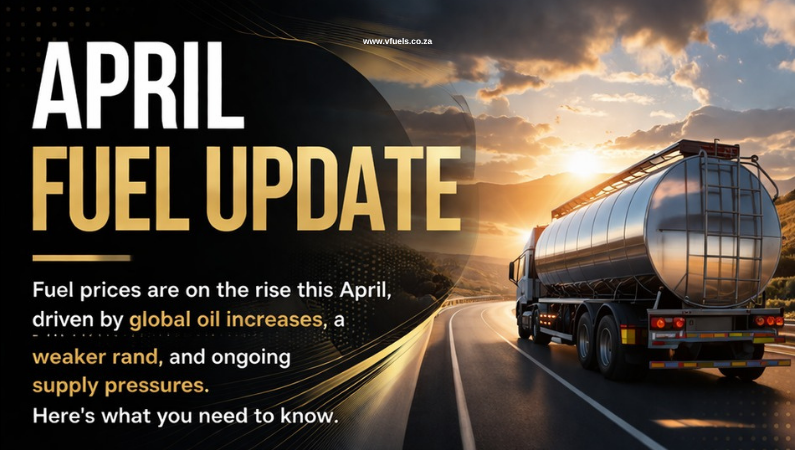
THE TRUE COST OF FUEL: WHY EVERY RAND NOW MATTERS MORE THAN EVER
Fuel price increases don’t just affect transport—they ripple through the entire South African economy. Every litre increase adds pressure across supply chains, from food production to construction and manufacturing.
When diesel prices rise, the cost of moving goods increases. This feeds directly into inflation, impacting everything from retail pricing to service delivery. For businesses, it’s not just about fuel spend—it’s about total operational cost.
In April, with upward pricing pressure expected to persist, companies need to rethink how they manage fuel consumption. The focus is shifting from price alone to efficiency and control.
Key considerations include:
- Monitoring fleet consumption more closely
- Reducing unnecessary trips and idle time
- Ensuring fuel quality to avoid engine inefficiencies
- Partnering with suppliers who offer transparency and reliability
This is where the difference between a supplier and a strategic partner becomes critical.
Virgin Fuels supports clients with:
- Real-time delivery coordination
- Verified fuel quality through laboratory testing
- Flexible bulk supply solutions
- Consistent availability across regions
In a high-cost environment, the cheapest litre is not always the most cost-effective. Reliability, quality, and efficiency now define true value.
Because in today’s market—every drop counts.
SUPPLY VS PRICE: WHY SOUTH AFRICA HAS FUEL—BUT AT A COST
Despite global instability, South Africa’s fuel supply remains stable in the short term. Government and industry stakeholders have confirmed that fuel shipments secured prior to recent geopolitical escalations will sustain supply into April.
However, stability in supply does not mean stability in price.
South Africa imports a significant portion of its refined fuel. This means that while physical availability is maintained, the cost of securing that fuel fluctuates rapidly based on global conditions.
Recent developments have highlighted a critical reality:
Supply security and price stability are not the same thing.
Even with adequate reserves, rising crude oil prices and shipping disruptions—particularly around key global routes—are increasing procurement costs. These costs inevitably filter down to the end user.
Looking ahead, government initiatives are focused on:
- Diversifying fuel import sources
- Expanding strategic storage capacity
- Strengthening infrastructure resilience
For businesses, this reinforces the need for proactive planning rather than reactive purchasing.
Virgin Fuels continues to ensure consistent supply through established procurement networks, while helping clients plan ahead in volatile conditions.
The takeaway:
Fuel may be available—but managing its cost requires strategy.
TAX, TENSION & TANKS: THE TRIPLE PRESSURE ON SOUTH AFRICAN FUEL COSTS
April introduces more than just global pressure—it brings local policy changes that directly impact fuel pricing. The latest national budget includes increases to the General Fuel Levy and the Road Accident Fund levy, adding further cost per litre.
While these increases may appear marginal individually, their cumulative effect—combined with rising oil prices and currency weakness—creates a compounded financial burden.
At the same time, public debate is intensifying around fuel levies. Proposals to reduce or temporarily adjust these levies highlight a growing concern: fuel costs are becoming a structural economic challenge, not just a market fluctuation.
For businesses, this “triple pressure” consists of:
- Global oil price volatility
- Exchange rate fluctuations
- Local tax increases
This combination places South Africa in a uniquely sensitive position compared to oil-producing economies.
The impact is already visible:
- Increased transport and logistics costs
- Rising input costs across industries
- Greater pressure on pricing strategies and margins
Forward-thinking companies are responding by:
- Securing supply contracts
- Improving fuel management systems
- Partnering with reliable bulk suppliers
Virgin Fuels works closely with clients to navigate these layered pressures, ensuring supply continuity while helping manage cost exposure.
In today’s environment, fuel strategy is business strategy
FROM RISK TO RESILIENCE: HOW BUSINESSES ARE ADAPTING TO THE NEW FUEL REALITY
South African businesses are no longer treating fuel as a fixed cost—they are treating it as a controllable variable. The shift is subtle but powerful.
In a volatile pricing environment, resilience comes from visibility, planning, and partnerships.
Leading companies are adapting in several ways:
- Strategic Procurement
Bulk purchasing and forward planning are helping businesses reduce exposure to sudden price spikes. - Operational Efficiency
Fleet optimisation, route planning, and reduced idle time are becoming standard practice. - Quality Assurance
Poor fuel quality leads to maintenance costs, downtime, and inefficiency—making quality a non-negotiable factor. - Supplier Partnerships
Businesses are moving toward suppliers who offer more than delivery—partners who provide insight, flexibility, and reliability. - Data-Driven Decisions
Access to consumption data and performance tracking is enabling smarter fuel usage and cost control.
At Virgin Fuels, our approach is built around enabling this resilience:
- Tested, quality-assured fuel
- Reliable delivery within 6–24 hours
- National supply capability
- Transparent communication and support
The market has changed—and the businesses that adapt fastest will gain a competitive advantage.
Because resilience isn’t about avoiding change. It’s about being ready for it.