
Dear Reader…
The fuel industry is going through big changes as we head towards a society focused on reduced carbon emissions. At the same time, unstable fuel prices are causing waves in the local economy, drastically affecting the ordinary citizen’s disposable income and disadvantaging the poor even more. Here’s what you need to know ‒ and what to expect ‒ as an industry expert.
Another Petrol Price Hike On The Horizon
More bad news for South Africans as March brings with it another severe petrol price increase.
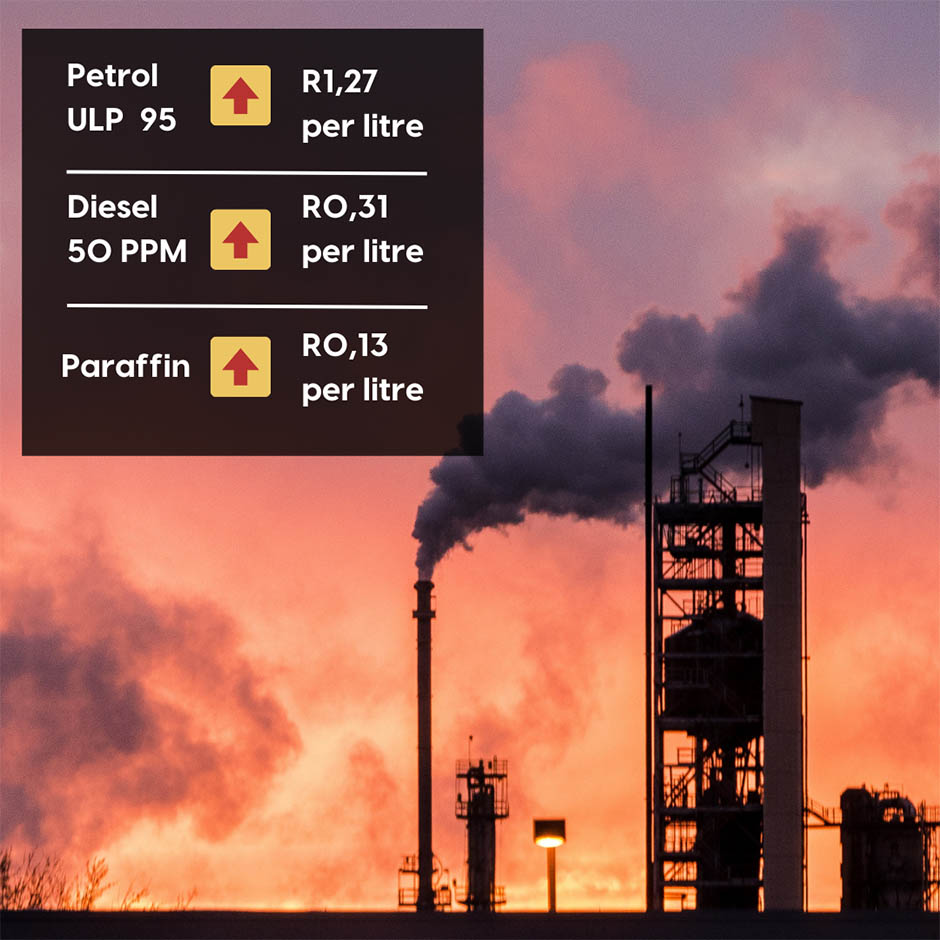
The Central Energy Fund data shows that a sharp spike in petrol prices is likely to occur over the next month. The Automobile Association is also expecting a jump in wholesale diesel and paraffin prices. The price is expected to climb by between R1.22 and R1.27 per litre for petrol, while diesel is expected to go up by about 28 c per litre. Paraffin is also expected to rise by 16c per litre in March.

The reason for the increased petrol price is due to international oil prices, which have risen by between 76c and 82c per barrel, in addition to a weaker average rand to US dollar exchange rate.
Relief For Food Manufacturers
With fuel prices being so high and the impact that this is having on food prices, Finance Minister Enoch Godongwana said during his budget speech on February 22 that he would extend an olive branch to food manufacturers by allowing a diesel fuel levy refund that would extend for two years, starting on April 1 and running until the end of March 2025.
This would be accompanied by no increase in the general fuel levy, which is expected to provide some relief to consumers by limiting the amount of money that food prices will be increased by.
The cost of fuel has had a significant impact on the price of food, not only because food manufacturers and agricultural industry participants have to use diesel in their machinery but also because of the widespread need for diesel generators amid extensive load shedding.

Biofuels Technology Could Revolutionise Trucking
A company called ClearFlame Engine Technologies is helping cargo-carrying vehicles such as trucks reduce their carbon emissions and also save on fuel costs by modifying their engines to decrease their carbon footprints.
The company’s solution allows them to run on various different plant-based renewable fuels, such as ammonia, methanol and ethanol. These fuels can be produced on a large scale around the world and provide significantly less harmful emissions than traditional fossil fuels.
These fuels can be produced from biomass. Through ClearFlame Engine Technologies, companies can ensure that costs are reduced by as much as 30%, while also reducing greenhouse gas emissions by about 42% when compared with fossil fuels such as diesel.
While the company has not commercially launched its technology yet, it plans to do so in the near future, perhaps as early as 2024. Since 2022, it has been testing the technology successfully, with its pilot trucks logging more than 800 000 km so far.
Pushback Against Ban On Petrol/Diesel Vehicles In The EU
As the world progresses steadily towards an electric vehicle future, the European Parliament has approved a law banning vehicles that run on combustion engines from being sold after 2035. The law is meant to help reduce carbon emissions and combat climate change.
However, some car manufacturing countries are pushing back, in particular Germany and Italy, which are known for producing some of the world’s most famous car brands.
Italy, which is home to brands like Ferrari, Alfa Romeo and Fiat, to name a few, has opposed the law. Italian Minister for Transport, Matteo Salvini, calls the law “ideological fundamentalism” that would spell “economic suicide” for the European Union (EU).
In addition to Italy’s pushback, Germany, which makes car brands like BMW and Volkswagen, has also called on the EU to roll back the new regulation. Germany’s Transport State Secretary, Michael Firor, called for the EU to allow combustion engines that use less harmful fuels, known as e-fuels or otherwise climate-neutral fuels.

Watch out for more newsletters as we work to keep you informed on some of the most intriguing and important news affecting the petroleum industry. See you next time!